
 09 Jan 2024
Dry eyes can be a nuisance at best, and a painful hindrance at worst, so anyone with dry eyes should seek treatment as soon as possible. Not only can dry eyes sting or itch, but when left untreated for too long, your eyes can be prone to issues, and you can develop further eye health problems.
Fortunately, GPs can help get to the root of the issue, and ophthalmologists can easily diagnose and treat dry eyes. Let’s look at how they do it.

Dry eyes can be a temporary issue or a permanent one, depending on the cause. Some people experience dry eyes periodically when their environment changes, or sometimes as a one-off, while others have chronic dry eyes due to other health conditions. Whatever the cause, the symptoms of dry eyes can be uncomfortable and painful and should be treated as soon as possible. The most appropriate treatment for dry eyes, however, is decided according to the cause.
When you experience dry eyes seemingly randomly, you can make a note of your environment to determine a cause and make changes accordingly.
Some environmental factors causing dry eyes include:
Each of these environmental factors can be easily changed by turning off air-conditioning, not smoking inside, wearing glasses while cycling or when outside in cold weather, or moving away from your computer periodically to rest your eyes. Aeroplanes may dry your eyes temporarily or for a few days after your flight, but they will usually go back to normal soon after.

Sometimes, making simple changes isn’t as easy to control the symptoms of dry eyes, as they’re caused by another health condition. Dry eyes can be caused by the lack of tear production, excess tear evaporation or ineffective tear production, all of which can be a result of another health condition or hormonal imbalance.
Some health conditions causing dry eyes include:
If you have dry eyes due to dehydration or vitamin A deficiency, you can change your habits to ensure you’re getting enough water and vitamin A to be healthy and keep your eyes moist. Similarly, chalazia can be treated, and your eyes should begin to moisten themselves again, and some medicines affecting your eyes can be changed to prevent dry eyes.
However, with conditions that are harder to treat, such as thyroid disorders or arthritis, you should seek treatment for your dry eyes as well as your health condition to ensure your eyes don’t sustain long-term damage from being dry, while you’re treating your other health problems.
As we get older, we produce fewer tears, leading to dry eyes in older age. This is more common in women as they experience more hormonal changes throughout their lives, which can further affect tear production. From starting periods to using contraception, getting pregnant and going through the menopause, there are many significant periods of hormonal changes in a woman’s life which may cause dry eyes throughout their life.
Women and older people should be careful to treat the symptoms of dry eyes as they appear to reduce the effect on their overall eye health.

While it may seem clear that dry eyes are perpetually dry, that’s not always the case.
Some symptoms of dry eyes include:
Tears are supposed to moisturise your eyes to enable blinking to clean your eyes from dust, dirt and grime, so when there is insufficient moisture, blinking can become painful, and feel like your eyelids are scratching against your eyes. This scratching sensation is somewhat real as the dust particles in your eyes are rubbing against the surface of your eyes. This causes your eyes to become irritated and go red in appearance.
When your eyes become inflamed and dry, you’re at a higher risk of developing eye infections like blepharitis or conjunctivitis, as the dirt in your eyes penetrates and irritates the surface, causing an infection and your eyes to produce white mucus to treat it.
Irritated and inflamed eyes can also cause your vision to become disturbed as it becomes increasingly difficult to focus. It’s very unlikely you’ll go blind after developing dry eyes without another eye condition causing substantial vision loss; however, if you leave your dry eyes untreated for a significant time, you can expect to lose some of your vision.
Dry eyes relate to a lack of moisture in the eyes, which can be caused by a lack of tear production, but also the lack of quality tear production. So in some cases, and somewhat counterintuitively, dry eyes can actually be very wet.
Tears are made up of water, electrolytes, proteins, lipids, and mucins, so when one or more components of your tears are missing, the fluid isn’t sufficient to effectively moisturise your eyes and clean them of dirt and grime. This can lead to very watery eyes as your body tries to cleanse your eyes by overproducing watery tears to make up for the lack of quality tears.
Overwatering your eyes is normal if you have something in your eye, like an eyelash or grit, or if you’re in a smoky or windy environment, so you don’t need to worry if your eyes are watering a lot temporarily. However, if you experience very watery eyes on a day-to-day basis with no obvious cause, you should see your GP or an eye specialist for advice.
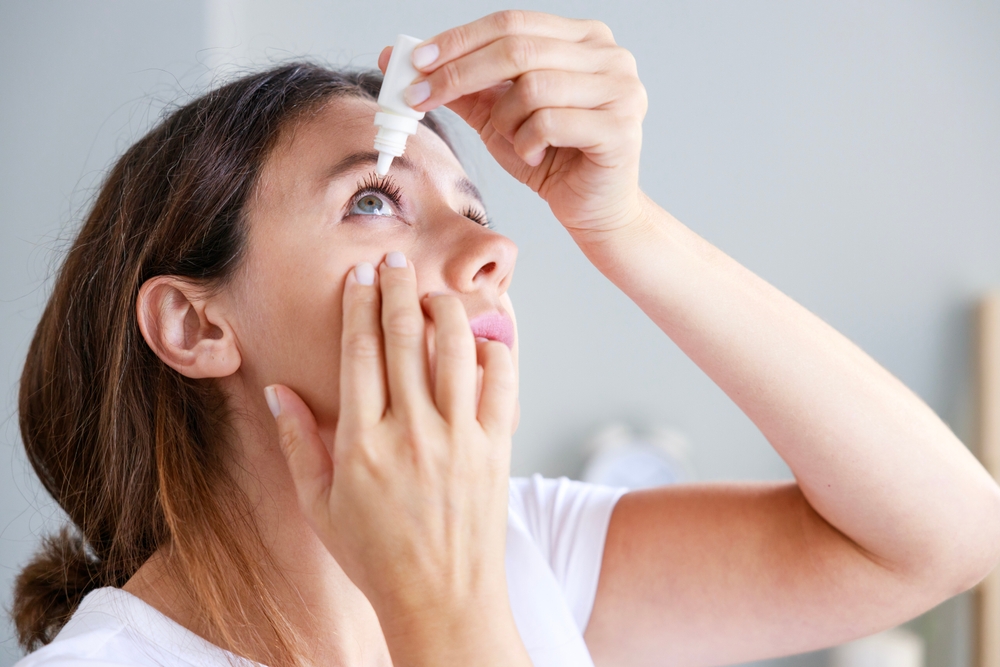
The most effective treatment for dry eyes is eye drops known as artificial tears. You can buy them over the counter at a pharmacy to treat the symptoms of dry eyes yourself; however, as dry eyes can have several different causes, you’re advised to see an eye specialist first to follow their advice on which type of eye drop will work best for you. Some also contain preservatives, which can irritate some people’s eyes and cause allergic reactions, so read the label carefully before use if you have any allergies.
To use eye drops, tilt your head back and look up, gently holding your lower eyelid down to create a small pocket for the drop. Add the recommended number of eye drops and close your eyes, pressing gently on your tear duct to prevent the liquid from being drained.
In most cases, you should treat the symptoms of dry eyes as well as the symptoms of your other health condition, if dry eyes are one of the symptoms, as prolonged dry eyes can cause other eye health problems.
If your dry eyes don’t improve with treatment with eye drops, you can see an eye specialist to investigate if another treatment may be more effective. There are two options for surgeries that can be performed for people with very severe cases of dry eyes: punctal plug insertion and Minor Gland Salivary Autotransplant.
Punctal plugs involve inserting a small mechanism into your tear ducts to stop liquid from draining from your eyes, which still requires the use of eye drops, while Minor Gland Salivary Autotransplant is a more permanent procedure. This involves grafting salivary glands from the inside of your mouth and placing them near your tear ducts to replicate tear production, which has been shown to be effective.
If you’re suffering from dry eyes, you shouldn’t wait any longer to see a specialist. Book an appointment with the Eye and Dental Clinic today, so an expert team can diagnose and treat your eye conditions as soon as possible. Read our latest news to find out more about eye health, or contact us for more information.
Back to Blog

Discover how our advanced eye and dental treatments have helped patients see clearly, smile confidently, and live better with personalised care, comfort, and lasting results.
View More











Hemlata T
Had a deep clean today with Alla and Rachel, which was great, they were very gentle and even fixed a stubborn stain between my teeth, which they noticed during the...

Abs
Great service all around. Dr Uddin was knowledgeable, kind and put me at ease when having a chalazion removed. He helped me a lot with follow-up care for blepharitis, taking...
Amanda K
If I could give more than 5 stars for Mr J Uddin, I would. The reception staff were really polite and helpful. I had my chalazion removal surgery 2 months...
Nicole
Very satisfying. Dr J. Uddin removed a cyst on my upper lid. He explained everything to me before and during the procedure, and he has a very calming appearance. The...
Hemlata T
Had a deep clean today with Alla and Rachel, which was great, they were very gentle and even fixed a stubborn stain between my teeth, which they noticed during the...
Abs
Great service all around. Dr Uddin was knowledgeable, kind and put me at ease when having a chalazion removed. He helped me a lot with follow-up care for blepharitis, taking...
Amanda K
If I could give more than 5 stars for Mr J Uddin, I would. The reception staff were really polite and helpful. I had my chalazion removal surgery 2 months...
Nicole
Very satisfying. Dr J. Uddin removed a cyst on my upper lid. He explained everything to me before and during the procedure, and he has a very calming appearance. The...